30 Minute Full Body Dumbbell Workout at Home to Build Muscle
You do not need a gym, complicated machines, or a huge amount of space to get in a solid full-body workout. With a pair of dumbbells, some energy, and enough room to move, you can challenge your entire body at home.
This 30-minute full body dumbbell workout at home combines squats, rows, lunges, presses, core exercises, and bodyweight movements. The goal is simple: move with control, focus on your form, and make each exercise count.
Table of Contents
| Sr# | Headings |
|---|---|
| 1 | How This Full Body Dumbbell Workout Works |
| 2 | Quick Warm-Up Before Your Dumbbell Workout |
| 3 | Sumo Squat With Hammer Curl |
| 4 | Single-Arm Dumbbell Row |
| 5 | Dumbbell Deadlift With Squat |
| 6 | Overhead Tricep Extension |
| 7 | Side Lunge With Lateral Raise |
| 8 | Dumbbell Curl to Press |
| 9 | Leg Raises and Glute Bridge Chest Press |
| 10 | Side Plank and Push-Up With Climber |
| 11 | Renegade Rows and Reverse Lunge With Curl |
| 12 | Cool Down and Stretching |
| 13 | Tips to Get More From Your Home Dumbbell Workout |
| 14 | Frequently Asked Questions |
How This Full Body Dumbbell Workout Works
The workout is designed as a sequence of paired exercises. You move through one exercise, follow it with another, and repeat the combination before moving on to the next section.
The original routine emphasizes good form rather than rushing through the exercises. That is an important point. Think of your workout like building a house: controlled, solid movements create a better foundation than simply trying to finish as quickly as possible.
You can use light dumbbells for the routine, although the transcript also notes that some movements, such as the glute bridge with chest press, may feel easier with heavier weights.
Before beginning, make sure you have enough space to move safely and a mat for the exercises performed on the floor.
Quick Warm-Up Before Your Dumbbell Workout
Do not jump directly into the heavier part of your workout. The routine begins with a short warm-up to prepare the body for movement.
Arm Circles
Start with your arms extended and make controlled circles. Begin with larger circles, then make smaller ones. Change direction after several repetitions.
This movement helps get the shoulders moving before the workout becomes more demanding.
Side Bends
Stand with your feet wide and gently lean from one side to the other. The movement should feel like a light stretch through the side of your body.
Standing Twists With Knee Lifts
Add gentle twists and bring one knee upward as you rotate. Continue by alternating sides.
Forward Bend and Runner’s Stretch
With your feet wide, bend forward while keeping your legs as straight as comfortable. Then transition toward a plank position and bring one foot forward for a runner-style stretch.
The warm-up does not need to be complicated. The key is simply to prepare yourself for the exercises ahead.
Sumo Squat With Hammer Curl
The first main combination works the lower body and biceps together.
Start by standing with your feet wider than shoulder width and turn your toes slightly outward. Hold the dumbbells between your legs.
Lower into the squat while keeping your chest lifted. As you stand back up, perform a hammer curl with the dumbbells.
Form Tips
Keep your chest up as you squat.
Engage your glutes and hamstrings as you stand.
During the curl, keep the movement controlled rather than swinging the weights.
This is a useful example of combining two movements into one exercise. Your legs work during the squat while your arms work during the curl.
Single-Arm Dumbbell Row
Next comes the back row.
Begin by standing with your feet about shoulder width apart. Hinge forward from your hips and push your hips backward while keeping your back straight.
From this position, row one dumbbell upward. Lower it under control and repeat on the other side.
Focus on Your Back
The workout instructions emphasize squeezing the back muscles as the dumbbell comes upward.
Avoid rushing the movement. Pull the dumbbell up, briefly focus on the contraction, and then lower it slowly.
Your core should remain engaged while you maintain the hinged position.
Dumbbell Deadlift With Squat
The next combination pairs a dumbbell deadlift with a squat.
Start with your feet around shoulder width apart and hold the dumbbells by your sides.
Push your hips backward as you lower into the deadlift. Keep a small bend in your knees and maintain a straight back.
Return to standing and then move into the squat.
The Most Important Detail
You do not have to force yourself to reach the floor during the deadlift. The transcript specifically emphasizes that good form is more important than going as low as possible.
Think about pushing your hips backward and then squeezing as you return to the standing position.
Overhead Tricep Extension
After the deadlift and squat combination, the workout moves to the triceps.
You can perform this exercise with one dumbbell using both hands, or work one arm at a time.
Raise the dumbbell overhead and slowly lower it behind your head. Aim for roughly a 90-degree elbow position before pressing the weight upward again.
Tricep Extension Form
Keep your elbows close together.
Point your elbows forward instead of allowing them to flare outward.
Lower the weight slowly.
Squeeze your triceps as you extend your arms.
The controlled lowering phase is especially important in this routine because the workout repeatedly emphasizes staying in control rather than simply moving quickly.
Side Lunge With Lateral Raise
Now the workout combines a side lunge with a lateral shoulder raise.
Start with your feet positioned wide. Move into a side lunge on one side, return toward the center, and lift the dumbbells outward into a lateral raise. Then repeat on the opposite side.
You can also simplify the movement by using one arm at a time if using both dumbbells feels too difficult.
The workout notes that you do not need to raise the dumbbells extremely high. A controlled, moderate range is enough for the movement.
Keep Your Shoulders Under Control
Do not swing the dumbbells upward. The goal is controlled movement.
The routine also cues you to lead the lateral raise with the pinky side of the hand. Most importantly, maintain control as you raise and lower the weights.
Dumbbell Curl to Press
Next comes another two-in-one exercise: the curl to press.
Begin with the dumbbells at your sides. Curl the weights toward your shoulders and then press them overhead.
Lower them under control and repeat, alternating as appropriate.
Keep Your Elbows Close
One of the main form cues from the workout is to keep your elbows close to your body during the curl.
Avoid allowing the elbows to drift forward or outward while you curl.
The movement should feel deliberate: curl, press, control the descent, and repeat.
Leg Raises and Glute Bridge Chest Press
The workout then moves down to the mat for two floor-based exercises.
Dumbbell Leg Raises
Lie on your back with your legs straight. Hold one dumbbell overhead and raise your legs while keeping your lower back pressed against the mat.
Slowly lower the legs before raising them again.
The important cue here is to avoid allowing your lower back to lift away from the floor. Adjust your movement rather than sacrificing control.
Glute Bridge With Chest Press
Next, hold the dumbbells and lift your hips into a glute bridge.
Keep the bridge position while performing chest presses. Lower the weights under control and press them upward again.
The workout emphasizes maintaining the bridge rather than repeatedly dropping the hips.
The transcript also points out that heavier dumbbells can make this exercise more challenging, especially when lighter weights begin to feel too easy.
Side Plank and Push-Up With Climber
After the dumbbell exercises, the routine adds bodyweight movements for the core and upper body.
Side Plank
You can perform the side plank with your hand supporting you in a high-plank position or use the elbow variation.
Lift your body and hold the position while breathing steadily.
If holding the full position becomes difficult, one modification in the workout is to lower one knee for additional support.
Focus on keeping your body stable and engaging your side muscles.
Push-Up With Climber
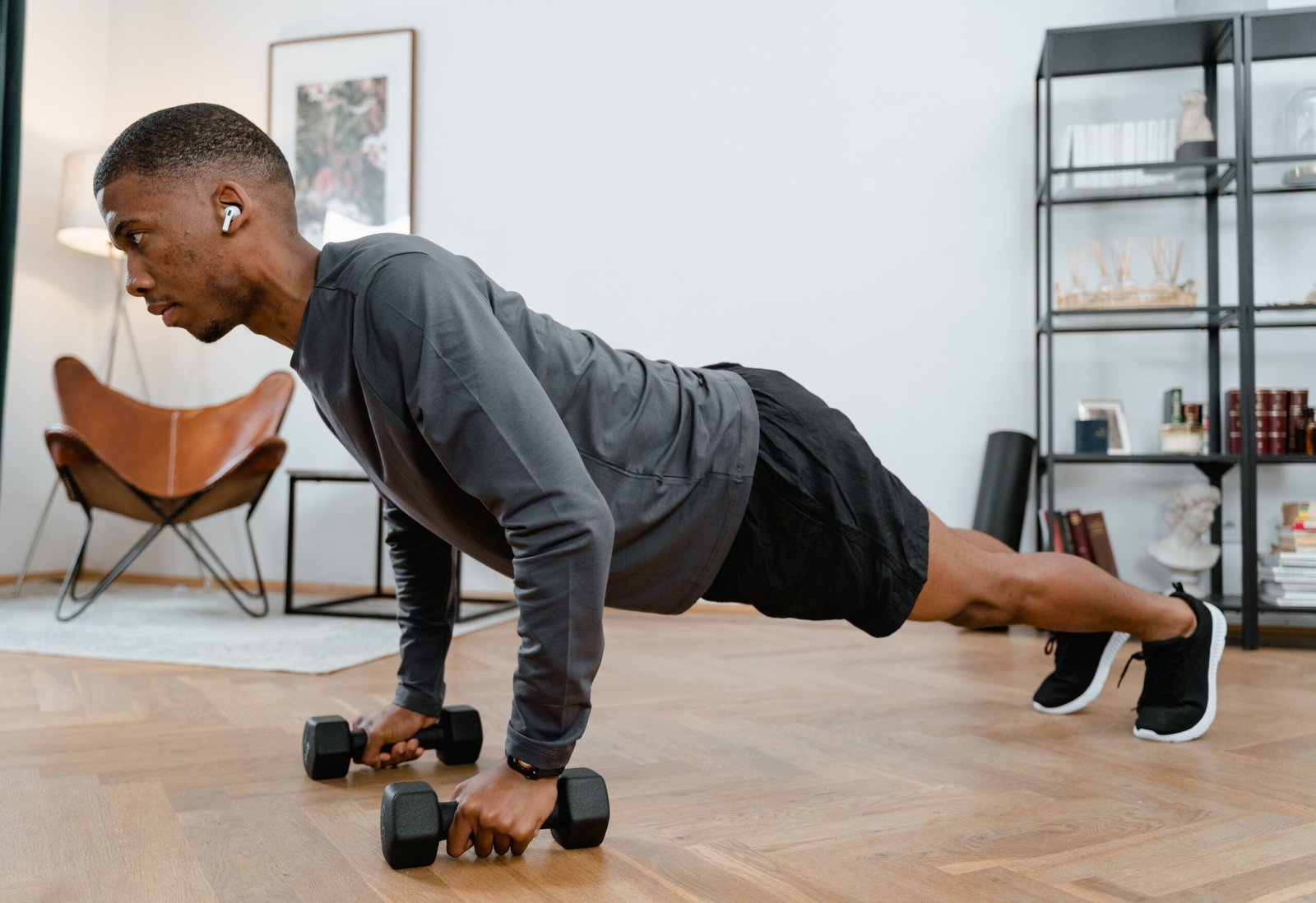
From a plank position, perform a push-up and then bring a knee toward your body.
Repeat the movement on the other side.
For a modified version, place your knees on the floor during the push-up and then return to the plank before bringing the knee forward.
The workout specifically reminds you to squeeze your abs as the knee comes in.
Renegade Rows and Reverse Lunge With Curl
The final challenging section combines another dumbbell back exercise with a lower-body movement.
Renegade Rows
Start in a plank position while holding the dumbbells. Row one dumbbell upward, place it down, and repeat with the other arm.
The workout strongly emphasizes keeping your hips facing toward the mat instead of twisting from side to side.
Modified Renegade Row
This exercise can be demanding. A simpler option shown in the routine is to lower your knees to the mat and perform the rows from that position.
There is nothing wrong with modifying the exercise. The goal is to maintain control and balance.
Reverse Lunge With Curl
Stand tall with the dumbbells in your hands. Step one leg backward into a reverse lunge, return to standing, and perform a curl.
Switch legs and repeat.
The workout suggests stepping back with enough width to help maintain your balance.
This exercise brings the routine toward its final stage by combining leg work and arm work again.
Cool Down and Stretching
Do not treat the final few minutes as an afterthought. The workout finishes with a short cool-down.
Knee Hugs
Lie on your back and bring your knees toward your chest. Take slow, deep breaths while holding the position.
Hamstring Stretch
Extend one leg and gently stretch the back of the leg. The routine allows for a small foot movement to change the feeling of the stretch.
Repeat on the other side.
Butterfly Stretch
Sit up and bring the soles of your feet together. Allow your knees to move outward while you gently stretch the inner thigh and groin area.
Glute Stretch
Bring one leg across your body, hold the knee toward your chest, and gently rotate your upper body if comfortable.
Repeat on the opposite side.
The cool-down provides a calm finish after the more demanding exercises and helps transition you out of the workout.
Tips to Get More From Your Home Dumbbell Workout
A good workout is not only about the exercises. How you perform them matters just as much.
Prioritize form. The workout repeatedly emphasizes controlled movement instead of racing through repetitions.
Use manageable weights. Start with dumbbells that allow you to maintain good technique. When an exercise feels too difficult, reduce the load or use the provided modification.
Control the lowering phase. Several movements specifically call for slowly lowering the dumbbells rather than letting gravity take over.
Keep your core engaged. This is particularly important during rows, planks, leg raises, and renegade rows.
Modify when necessary. The routine offers easier variations, including using one dumbbell, working one arm at a time, or performing certain plank and renegade-row exercises from the knees.
Take short breaks when needed. The workout includes opportunities to catch your breath and drink water before continuing.
Most importantly, remember that consistency matters. A single workout can be challenging, but repeating a sensible routine over time can make it much easier to build a regular exercise habit.
Frequently Asked Questions
1. Can I do this 30-minute full body dumbbell workout at home?
Yes. The workout is specifically designed to be performed at home using dumbbells, a mat, and enough space to move comfortably.
2. What equipment do I need for this dumbbell workout?
You mainly need a pair of dumbbells and enough open space. A workout mat is also useful for floor exercises such as leg raises, chest presses, and planks.
3. Can beginners do this full body dumbbell workout?
The routine includes several modifications for challenging movements. Beginners can reduce the weight, work with one dumbbell, use the knee-supported versions, and focus on learning proper movement.
4. Should I use heavy or light dumbbells?
The workout can be performed with light weights, but some movements may become easier with heavier dumbbells. Choose a weight that allows you to maintain control and proper form throughout the exercise.
5. What muscles does this workout train?
The routine combines movements for the legs, glutes, hamstrings, biceps, triceps, shoulders, back, chest, and core, making it a broad full-body session.
Conclusion
This 30-minute full body dumbbell workout at home gives you a practical way to train your entire body without needing a gym. From sumo squats and rows to presses, lunges, planks, and renegade rows, the routine combines strength-focused movements into one complete session.
The biggest lesson is simple: quality beats speed. Use controlled movements, choose suitable dumbbells, and modify exercises when necessary.
Ready to get started? Grab your dumbbells, clear some space, complete the warm-up, and work through the routine one exercise at a time.
For questions, suggestions, or feedback, contact us at: [ info@fitleaper.com ].